We argue that tying well is a constant balancing act that happens among these four priorities. What’s important for us is that both tops and bottoms understand the trade-offs that are being made among these priorities, as well as options for intentionally tipping the scales in the desired direction when needed.
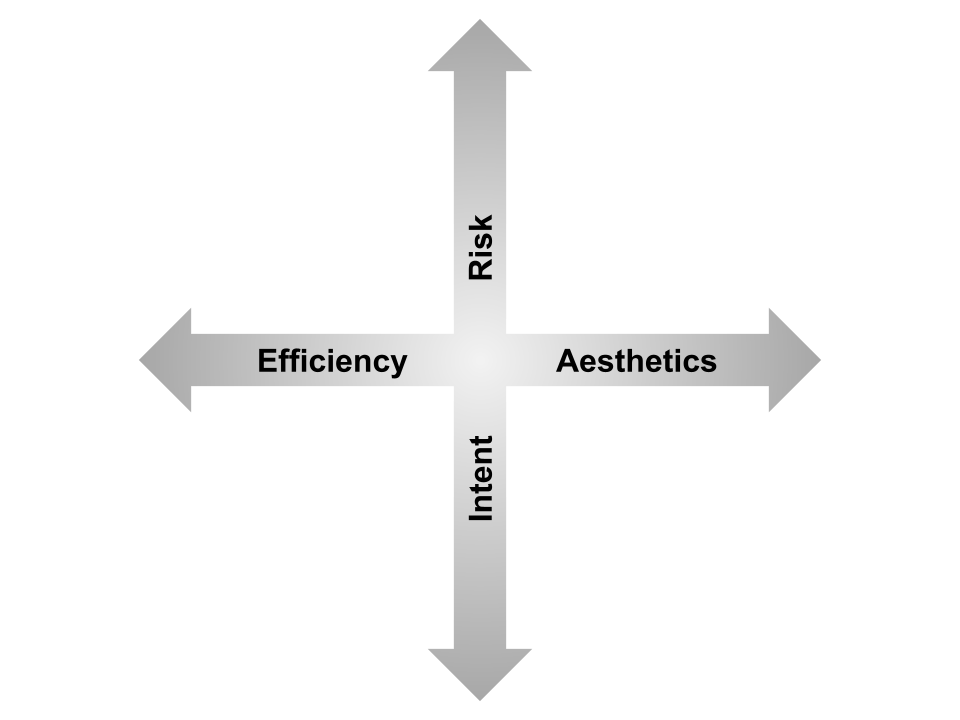
For example, there may be a more efficient way to do something, but that efficiency may introduce greater risk … or there may be a way to make the tie more aesthetically pleasing, but at the cost of efficiency … and so on.
We encourage tops and bottoms to be conscious of this balancing act as they make decisions in constructing and/or negotiating a tie and to keep themselves aware of the implications that their choices have on each of these priorities. We also list these priorities in order of most important to least important for the purpose of mitigating risk (though, for example, we recognize that aesthetics may trump all else for experienced artists in pursuit of a specific performance or image).
We also stress that risk should never be compromised unless that choice is understood and consented to by all participants. In other words, if tops are going to sacrifice safety in the pursuit of other priorities, their partner(s) should be giving their informed consent to that choice.
This will also vary according to the kind of interaction (practice, play, or performance) and the shared intention of the participants. For example, if the intention is to learn a skill, then the interaction will focus on practice, and technical accuracy may be the goal at the expense of efficiency. However, for play, aesthetics may not even be considered, with risk being the only principle of any concern, and even then, if the goal is a heavily-sadistic rope interaction (with all due informed consent), the risk is concerned only with avoiding injury and not with preventing stress.
Finally, we recognize efficiency as a direct result of “control” as explained in the Tying Well section. Efficiency is developed over time through better control of the rope, of yourself, and of your partner. It also develops through muscle-memory, not needing to think through each step consciously, and the like.
All of this also contributes to speed. Initially, when learning a tie (or when learning to tie in general), speed should be at the very bottom of the list of priorities. However, as skill improves and you begin working with more strenuous ties, including partial and full suspension, speed as it results from efficiency (without sacrificing other aspects) becomes an important factor and can directly impact the degree of risk.