While we will continue to stress that rope bondage can be dangerous, we also want to take a minute to recognize that part of the excitement of rope bondage is the physical stress it causes in the body. Learning what kinds of stresses and sensations are normal, and therefore something you can learn to enjoy, is just as important as learning about all the “danger signs.”
It’s also normal to be fearful about being injured. Part of your journey as a rope bottom will be learning to balance that fear with the enjoyment of the physical and mental/emotional stress that rope bondage can bring–or at least, learning which fears are unfounded and learning which warning signs need immediate attention versus mindful attention until later. Progressing at a manageable pace, introducing one new risk factor at a time, can help you find that balance.
Another strategy that should help you to find that balance is learning how to effectively monitor yourself in rope and developing more informed decision-making strategies. This topic focuses on those goals.
When to Monitor and When to Let Go
As we said above, the goal of all of this work is to help you enjoy the rope more fully with less fear and risk of injury.
And to be explicit for a moment, by “enjoy” we mean any or all of the following:
- Have fun and be silly in rope
- Sink into the rope in a deep and meditative way
- Enjoy losing yourself in the “rope space” experience
- Push yourself physically in the rope
- Perform for images or an audience
- Enjoy sexual pleasure in the rope
- And the like …
In our opinion, the best way to develop the ability to do those things without risk of injury is to follow this cycle:
- When a new risk is introduced (a new position, a new tie, a different level of tension, adding load through up-lines, etc.), monitor yourself closely as you and/or your partner are learning together. This means staying focused, paying careful attention to your body, communicating clearly and often, and using other strategies like the ones listed below.
- Over some time practicing with that new risk in that way, you should gain a sense of how your body responds, the level of risk involved for your body, ways to effectively process the new risk (which we’ll address in a later topic), and whether or not any aspect of the risk is unworkable for you and your body.
- As you gain confidence in those things, you can then move into enjoying the new risk. You won’t need to monitor yourself as closely all the time because you’re familiar with how your body responds, which warning signs you can safely ignore, the types of stress you can process without injury, and the indicators that you’re reaching the limit of injury-free rope and need to change something or stop.
- Then … repeat by adding the next new risk.
Over time, you will build up an experience-based, body-informed collection of risks that you know you can enjoy and/or process without injury. This is a large part of what we mean by “responsible progression” for bottoms.
This is another way of talking about the distinction we mentioned earlier between different types of rope interactions: practice, play, and performance. Monitoring can be important during any of those, but is particularly important during practice and when exploring new risks.
Learning to Monitor Yourself in Rope
Monitoring yourself in rope requires focus and paying attention to your body. This means it’s usually best to avoid chatter (unless communicating about the rope), play, and other distractions. This is also not the time to “sink into” the rope or lose yourself in “rope space.”
Also note that the rope top should be your partner in this work–helping you to monitor through outside observation, effective communication, and “checking in” as you practice.
Mentally run through all the parts of your body, head to toe, thinking about what you’re feeling, gauging the level of stress in each part, and deciding what needs to be managed. For each thing you notice, decide if this is:
- something that can be safely ignored
- something that can be ignored for now but should be monitored
- something you need to address but can manage or process on your own
- something you need your rope top to be informed about and/or address to help you manage or process
- something that your rope top needs to address immediately (such as changing your position, moving or removing rope, or untying you completely)
Check the Tie
At an appropriate time (see Working Together in Rope), flex into the tie to test the placement and tension. If you can make adjustments to your body to manage anything that presents itself as a problem, do so. If you need your rope top to address something, inform them.
Also consider your exit strategies in any tie or position (but not so that you can become an escape artist!) Instead, thinking through how the rope went on the body and how you were moved and position during the interaction can help you think through the best way to come out of a position or a tie that will involve the least amount of risk for your body. Learning to do this can become extremely valuable as the risk level of ties increase and/or as you begin practicing suspension.
Check Your Breathing
Make sure you keep breathing! Use your diaphragm (tie and position permitting). Maintaining slow, controlled breathing as much as possible will help you stay focused and better manage the stress of a tie. If it becomes shallow or excessively slow or rapid, these could be signs of hypoventilation or hyperventilation, both of which can cause fainting or other serious medical concerns.
Check for Discoloration
Limbs will discolor when constricted with rope, and this reaction is normal in most people. The exact shade and degree of discoloration will vary from person to person and may depend on skin pigmentation. In general, some darkening or discoloration that adds red undertones to the skin is not typically a major concern for short periods of time (about 15-30 minutes) in most people. However, be careful when extending that time, as discoloration is an indicator of circulation loss, which can mask the more serious indicators of nerve compression. Also, if the color starts to shift into deeper shades of purple or takes on a gray or “ashen” look, we recommend removing the constriction as quickly as safely possible. (Also note that circulation loss can be more dangerous for people with certain conditions or risks and should therefore be monitored more closely.)
Check for Limited Flexion or Extension
The inability to fully flex or extend certain parts of the body can be indicators of nerve compression. We recommend that bottoms and tops use established checks to monitor these motions (see below).
Check for Loss of Sensation or Intense Sensation
The loss of sensation or some forms of intense sensation such as: burning, tingling, “electric crackling,” or noticeable itching on hands, feet, and limbs can indicate either circulation loss or nerve compression. Because of the risks associated with nerve compression, we recommend taking these sensations seriously and making informed decisions about the response. Pay particular attention to these areas:
- Top of thigh or knee; weakness of knee or leg
- Inner side of lower leg / calf
- Top of the foot; inability to raise foot toward shin
- Top “inner” part of hand; inability to lift hand or give thumbs up
- Top “outer” part of hand; inability to turn hand
- Palm side of hand; inability to curl hand
Immediate Concerns: Pain, Nausea, or Dizziness
Pain is an indicator that something is wrong. Dizziness or lightheadedness often immediately precedes fainting. Nausea is a distressing symptom and indicates the body is having an extreme reaction.
While you are entitled to make choices about how you will react these indicators based on the degree of risk you’re willing to take (see below), we believe they should be communicated immediately and action should be taken to address the concerns.
Losing the Ability to Monitor Effectively
If you are approaching the point where you feel you can no longer monitor yourself effectively in rope, you should communicate this to your tying partner. Whether or not the rope stops at that point is a decision you can make together, but your partner should know this shift is occurring as it elevates the risk and shifts more of the responsibility onto them.
Typical reasons for no longer being able to effectively monitor include:
- Rope Space – The sensation of “sinking into” or “losing yourself” in the rope. Warn your partner if you feel you are about to move into this type of headspace, which will likely impair your ability to communicate effectively.
- Difficulty Processing – If you start to have trouble processing the tie for whatever reason (see Processing Stress), you will be less effective at managing your body in the rope, and your rope partner should be informed.
- Fatigue – Obviously, as your energy wanes, your ability to monitor and process will decrease. Your partner should know when you’re nearing that point.
Decision-Making
Decisions are being made in rope throughout every interaction–whether the participants are aware of those decisions or not. Our goal here is to help bottoms to make those decisions explicit so that both parties can be consciously aware of those decisions and can explicitly consent to them.
Our discussions about monitoring so far have been focused on awareness: learning to listen to your body in rope and getting to know how your body responds in rope. Now, we want to take the next step and start thinking about the decisions we make in response to the things we notice.
We developed the flow chart below in cooperation with a number of experienced bottoms in order to help other bottoms become more explicitly conscious of the decision-making that is happening during rope when the body is experiencing stress. In our experience, these decisions are always being made, but not always in a conscious manner or in a way that is communicated with the top.
This “hidden” decision-making can be dangerous because it often leads to bottoms pushing themselves in unnecessary ways (so the scene won’t stop, so they won’t be viewed as weak, so they won’t seem to be complaining, etc.) and to tops having their own consent violated because they aren’t aware of the bottom’s decisions about risk-taking. We urge our students to make their risk-taking explicit so that all parties can choose to consent to those risks or not.
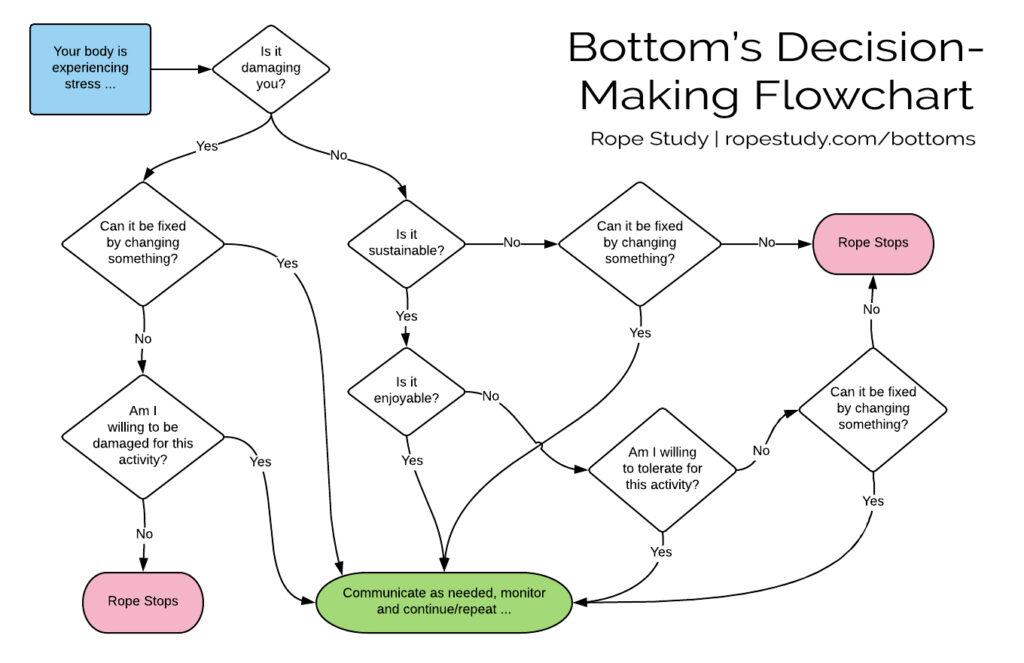
A few notes on the chart:
- “Is it damaging you?” – If you, as a bottom, have difficulty answering this first question with certainty, we urge you to:
- slow down and learn more about your body in rope and the related risks, which probably means you’re in a tie that is too far above your experience level, and
- realize the need to accept appropriate responsibility if you answer that question incorrectly.
- “Am I willing to be damaged for this activity?” – You have the right to accept risk of damage in pursuit of something you want. People do that all of the time in a wide variety of activities. However, it’s important to remember that, if you are working with someone else, you are not alone in that decision. It is imperative that you have negotiated your acceptance of this risk in advance and that you communicate this risk during the interaction. To not do so is to violate the consent of the top.
- “Communicate as needed …” – How you communicate can make a big difference in the “success” or “failure” of the interaction. In our advanced courses, we examine specific communication strategies to make communication more effective. For now, just remember that the best approach is direct, specific feedback about your experience in the rope (“my right knee is hurting”) delivered in as helpful and kindly a tone as possible. But also, when things really hurt, they really hurt, so …!
Note: We believe that it is important for bottoms to take responsibility for their experience in rope and their own safety, and we believe communication is an essential tool for doing so. However, we also acknowledge that communication is dependent on someone listening to and responding to that communication. So, while our focus in this section is on helping bottoms to successfully and responsibly manage their side of a rope interaction, we do not mean to minimize the role and responsibility of the top to elicit communication, to check in frequently, to listen and respond appropriately, and follow positive consent practice. (See more on this in the “Basics for Tops” section.) This section is about helping bottoms develop positive tools for rope interactions, not an excuse for top’s to claim ignorance, abdicate responsibility, or violate consent.
Here’s another take on this concept: “Good pain, bad pain, and rope bottoming“