We believe that one of the greatest dangers in rope comes from tops and bottoms moving too quickly into challenging and dangerous ties because they don’t recognize the limits of their own capabilities. In other words, people who don’t know what they don’t know, and so they push themselves or their partners beyond their ability without realizing that they’re doing so.
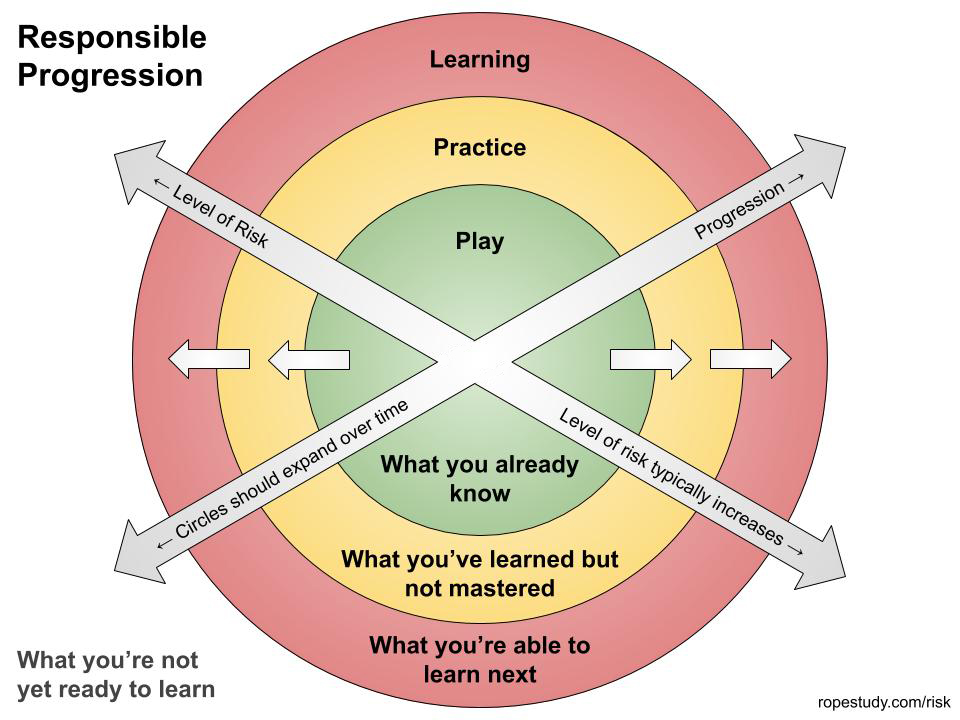
As you begin studying rope bondage, we encourage you to take your time and enjoy every stage of your progression. There will always be risk involved, but if your progress keeps pace with your learning, you can introduce those risks in a more-controlled manner and reduce the likelihood of injury. We don’t want to make people afraid of rope, but we do want people to respect the risks involved.
All of this is particularly true about suspension work. You should recognize that rope suspension is edge play, can be very dangerous, and can result in serious injury. And since bottoms are the ones taking the majority of the risk in suspension, we highly recommend that they take time to learn about the rope, the risks, and how their body responds in rope in a controlled, progressive manner over time before allowing someone to suspend them. (We recommend many months of serious study and preparation, not hours or weeks.) We also strongly encourage bottoms to thoroughly vet any top they are considering practicing suspension with.
Here’s a secret: the actual mechanics of suspension are pretty simple. There are 2 or 3 primary ways to attach to a tie, a few tips for controlling your lifting and lowering, and 2 or 3 primary ways to appropriately lock off the up-lines … all of which you can learn in a weekend. But most injuries don’t have anything to do with those mechanics. Most injuries happen because the top never learned to tie well on the body, and the bottom never spent the time necessary to understand their bodies in rope. And yes, there are concepts like levels, order of transitions, body mechanics, and the like, but the #1 problem in suspension is that tops never took the time to learn to tie well (before the up-lines) and bottoms never took the time to learn to really understand their bodies in rope.
Progression is for Bottoms, Too!
Most people generally accept that tops shouldn’t pick up rope for the first time and try to suspend someone. In fact, most people with any real experience in rope bondage will claim anywhere from 6 months to 2 years as the minimum time required before a top should suspend.
Yet, for some reason, the same isn’t often said in relation to bottoms. It’s not unusual to see a bottom who’s brand new to rope (from a few days to a few months) getting suspended. Our theory for why this is the case is that many tops and bottoms believe there isn’t much for bottoms “to know” … they’re just “bodies to be tied.”
To the contrary, we believe strongly that rope bottoms have an equal responsibility to be educated. While it’s possible that someone brand new to rope can get tied up and suspended by an experienced rope top, we believe this adds unnecessary risk and is an irresponsible act for both parties. New bottoms don’t truly understand the risks they’re taking (so, their consent isn’t truly informed), they have little to no previous experience by which to gauge their reactions in rope and assess the degree of risk different sensations and moves present, they can’t recognize good placement, tension and control on the part of the top, and aren’t experienced in communicating in rope bondage. Tops tying inexperienced bottoms are therefore flying blind, for the most part, as they cannot accurately trust the reactions and communication the bottom offers (or fails to offer). This is why we claim that bottoms must learn to progress in rope in a manner similar to tops. (And we would even add that, in terms of mitigating risk, the experience of the bottom is more important than the experience of the top.)
For one prominent take on this point, please consider this post from Gorgone / Marika Leila’s Instagram about the dangers of moving too quickly from a bottom’s perspective. (Gorgone is a professional rope bottom, rope top, and performer who has tied with nearly all of the most well-known rope tops and bottoms working at the professional level). She writes:
(Also see her follow-up post that offers advice to tops for how to help bottoms protect themselves in rope.)
We’ve heard similar stories from many experienced rope bottoms, all with a similar theme: I wish I had moved more slowly when I first got into rope and not allowed myself to feel pressure to “be cool” but instead had taken the time to really get to know my body in rope, discover my limits and risk profile, and protect myself better physically and emotionally.
See the sections directed specifically at bottoms later in this course.
For more on the rationale behind our push for responsible progression, we recommend taking a few minutes to read the following articles, particularly if you’re not already convinced. “The Hidden Risks of Learning Suspension Too Fast,” fuoco’s “On Bottoming Responsibility,” and Ma’iitsoh Yazhi’s writings “Hi! Will you suspend me?” and “Dangling Objects: On Responsible Progression in Rope.” And to further drive the point home, here’s one unfortunate example of rushing into dangerous territory without education: “Shibari and radial nerve damage – an experience and a warning.” (As we’ve said before, education and experience is not a guarantee that you won’t be injured, but you greatly increase your chance of injury by moving too far and too quickly beyond your current experience and skill set and/or those of your partner.)
Advice for Progressing in Rope
Here are some strategies we’ve found useful to progress in rope at a manageable pace.
Take Advantage of “Easy” Ties
Ties that have “lower risks” associated with them are excellent for focusing on placement, tension and control (for tops) or testing your body in and against the rope and allowing you to better focus on and monitor your reactions (for bottoms). This also helps prepare you for ties with greater risks, as you’ll be establishing a baseline of “normal” for your handling of rope (tops) and how your body responds in rope (bottoms).
Gradually Increase the Risk
Try to limit the number or degree of “new risks” you are taking in a given tie so that you can focus on one thing at a time and be able to pinpoint what has caused any concerns or issues that occur.
Stay Mindful
When practicing, and particularly when taking new risks, stay focused and cognizant of what is happening with the rope, your partner, and your/your partner’s body in the rope.
Increase Risk with Help
Whenever possible, practice adding a new risk with the help of a spotter or more experienced person who can assist when needed, provide guidance, or offer an outside perspective.
Debrief
After you tie (particularly for practice), have a conversation with your partner about what happened, what worked, what didn’t work, and what you might do differently next time. (This conversation not only helps you and that partner, but it will help you to translate your experience to new situations and partners.)
Safety vs. Comfort
Sometimes, the bottom might prefer certain things to happen during a tie because it “feels right” or feels “comfortable” or is “what they’re used to.” This can relate to rope placement, the way they hold their body, how tight they prefer the rope, or a range of other factors. However, try to stay mindful that comfort isn’t necessarily the same as safety.
We’re not at all saying that bottoms shouldn’t listen to their body, but if you’ve been given specific advice intended to reduce risk and you’re tempted to ignore that advice because it’s not what one or both of you are “used to,” stop and explore that issue further before dismissing it.
On the other hand, everyone’s body is unique, and as you learn more about rope and how your/your partner’s body responds in rope, don’t be forced into something that you know isn’t right for you simply because it’s the commonly accepted norm.
Responsible Progression & Enjoyment
Rope is meant to be enjoyable (however you define that), but to enjoy it in ways that mitigate the risks, we recommend you keep your “play” or enjoyment of rope confined to the types of ties and experiences that you’ve already gained some mastery over during your practice. (See “Types of Rope Interactions” for more on this concept.)
In your practice, you’re focusing on skills and communication and reducing risk and improving the tie and learning your body in that tie or those positions, etc. That’s important work, but isn’t always “enjoyable.” However, remember as you do that work that as you continue to learn new things and bring them into your practice, the ties and experiences that you can comfortably “play with” in responsible ways will continue to grow.
We also offer this advice: when you are untying, there is usually less need to be as focused on the skills and learning. We suggest that you use the untying stage during your practice to “play” and enjoy the rope. This will give you and your partner the chance to take a quick mental break, to enjoy each other and the rope together, and to not burn out on the practice stage!