We title this “processing stress” rather than “processing pain” as a way to call attention to an important point: in the language of your body, pain means something is wrong.
Now, we understand the masochistic impulse and realize that part of what many rope bottoms enjoy about rope is the “pain” they experience in challenging ties. Nevertheless, that pain is still your body’s way of telling you about a problem or potential problem.
We also want to highlight that your body can experience stress in the absence of specific pain … the stress of a challenging contortion, or of a muscle under extended flexion, or of the body in inversion.
Step One: Identify and Decide
In either case, the first steps in enjoying the stress or pain of rope is to recognize it, identify it, and decide what it means and what risks you’re willing to take as a result. Refer back to the Decision-Making Flowchart and the discussions we’ve had in earlier topics about mindful bottoming and informed risk-taking in the context of consent and shared risk profiles.
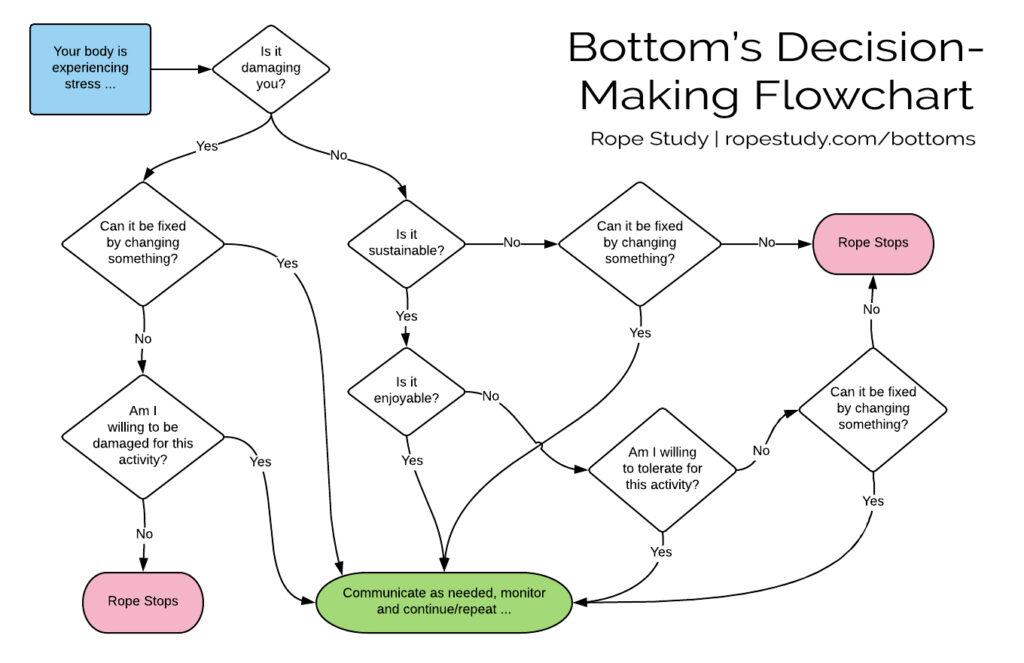
A few examples:
Example 1: The pain could be coming from the stress of a muscle, which you decide isn’t damaging in any lasting sense, and which you choose to sink into and enjoy.
Example 2: The pain could be coming from a joint that’s being over-extended, which you decide is manageable as long as it isn’t pulled further. At this point, you need to decide if damage to that joint is a risk you’re willing to take. You will also likely want to communicate to your top about the potential dangers there and your related decision (“don’t let that joint be pulled any further” if you decide to take that risk or “that joint is over-extended and in pain” if you decide not to take that risk).
Example 3: The tingling and loss of sensation (stress, but not pain) could be coming from a compressed nerve. In that case, you would definitely want to communicate that to your top and make changes to the tie to address that concern.
Step Two: Processing
For some types of physical stress, the best method for processing it is to prepare and train for it. For example, yoga or flexibility training can help you to process ties that contort or stretch the body and joints.
In addition, some of these methods may be helpful during the ties themselves:
- Visualization: “see” the pain being “thinned” as it’s spread to other parts of the body, or visualize your strength as you move beyond the pain
- Breathe into the painful area
- Shift your weight to move in the rope and redistribute the stress
- Give yourself 30 seconds to see if you adjust to the stress or pain
- Welcome and enjoy the stress or the pain (similar to what many do when exercising)
- Vocalize to make the pain external (moaning, loud breathing, etc.)
- Remember that you’re in control and can end the scene at any time (this may also help to reduce any fear)
Resources on Breathing: learning to be aware of your breath and to control your breathing (shallow/chest breathing versus deeper/diaphragm breathing) can help make your rope experiences more sustainable. Below are some resources that can help you practice your breathing and gain better control:
- Breathing in Suspension (Fetlife) – sansblague
- Ujjayi / Victorious Breathing in Yoga (YouTube Tutorial) – EkhartYoga (from above article)
- Diaphragmatic Breathing to Assist with Self Management of Pain (article)- VHA Office of Patient Centered Care & Cultural Transformation
- Lion’s Breath (YouTube Tutorial) – Yoga with Adriene
- Breath of Fire (YouTube Tutorial) – Yoga with Adriene